How a parcel moves, checkout to delivered
Hezalli Express is the marketplace's own fast-delivery arm — now a complete last-mile network. The buyer pays for speed at checkout, the seller hands the parcel to Hezalli directly or through a partner point, and one of our own couriers delivers it — every handover proven with a QR scan.
Where it begins
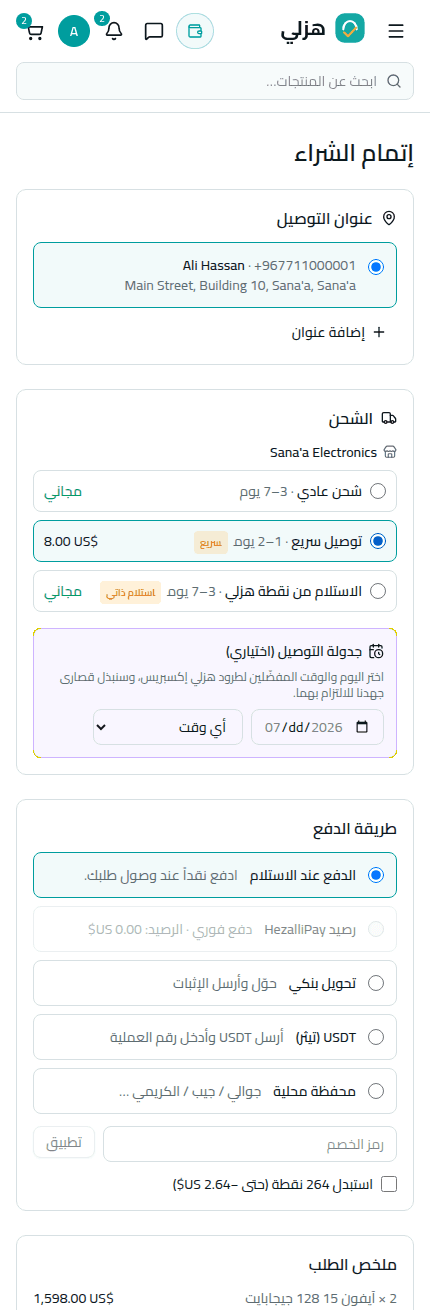
Three options at checkout
The buyer picks a shipping tier per seller in the cart. The fee is always recalculated server-side — a tampered client price never sticks.
3–7 days · zone-based
Normal shipping. A store's "free over $X" offer waives this tier only.
1–2 days · flat premium
A separate fee — the seller's per-zone price, or the platform default. Always charged, never waived.
From the nearest Hezalli Point
The buyer collects their own parcel from a partner shop. Shown only when an active point exists; unavailable for freight.
The journey
One Express parcel, six moves
- 1
Buyer picks Express and pays
Sees the fee and delivery estimate, chooses Express for that seller, and checks out. Freight items require a delivery window.
- 2
Seller ships direct or via a Hezalli Point
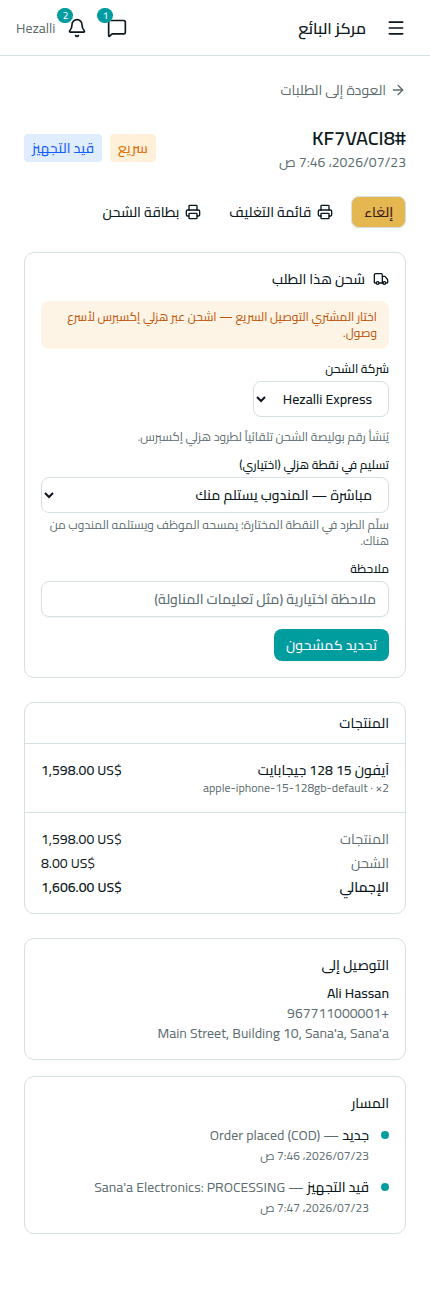
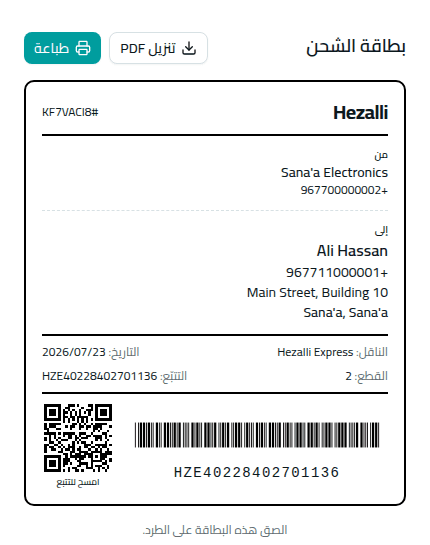
Hits "Ship" — the carrier defaults to Hezalli Express — and a label prints with a QR code and barcode. The parcel can go straight to a courier, or drop at a nearby point.
- 3
The platform offers it to a courier — automatically
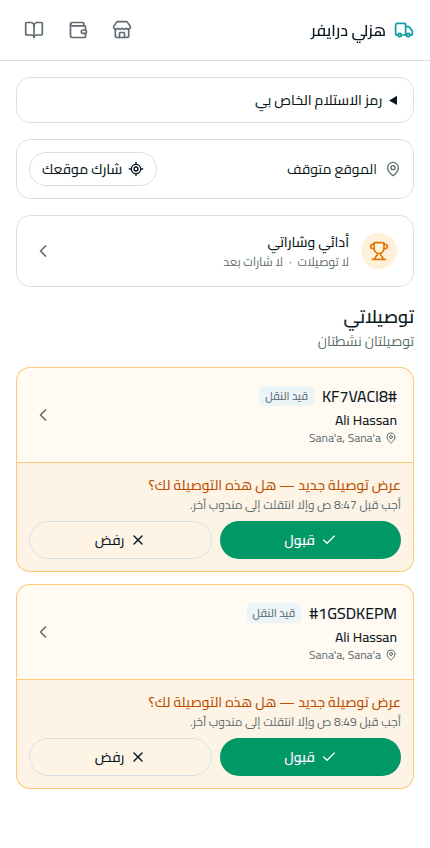
The moment it ships, the best-fit courier (by balance or true distance) gets an offer with a time limit to accept or decline. With the job board on, any eligible courier can claim it themselves.
- 4
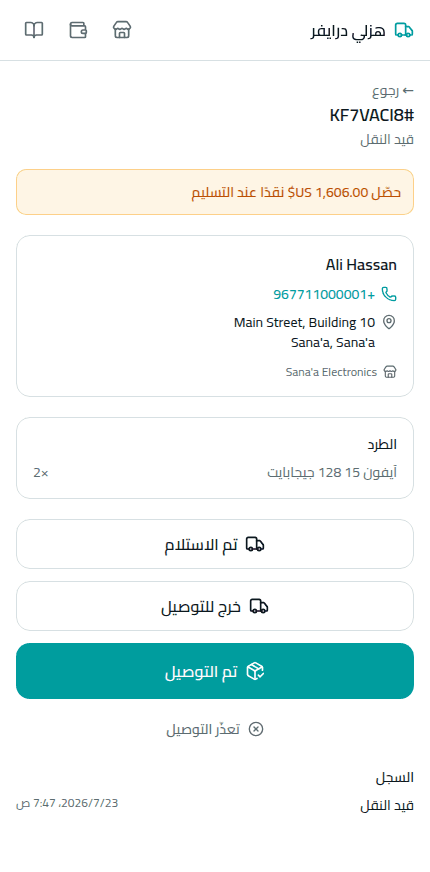
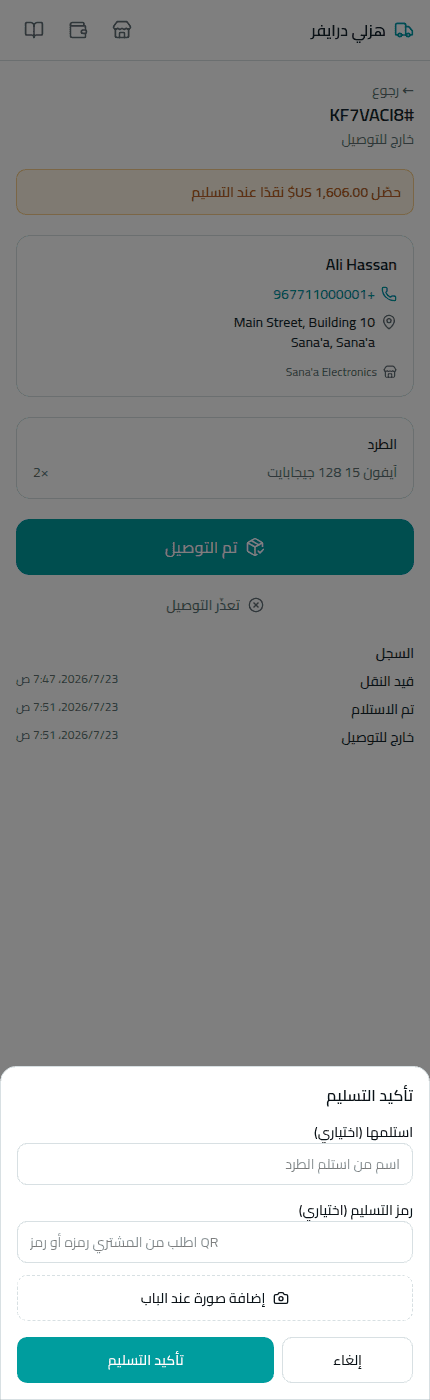
The courier scans, delivers, and captures proof
Advances through Picked up → Out for delivery → Delivered, collects cash on delivery, or logs a failed attempt with a reason.
- 5
When it stalls: reschedule or return
A failed parcel stays retriable and the buyer can request redelivery. After the attempt limit, it auto-returns to the seller with a refund or cancellation.
- 6
Money and completion
Delivery starts an auto-complete countdown. The buyer confirms receipt, the seller is settled, the courier's fee accrues, and the buyer rates the courier.

Stage three, in depth
How a parcel finds a courier
Two channels working together: offers pushed to a chosen courier, and an open board couriers pull from themselves — both under the same gates.
Sequential offers
The chosen courier gets a notification and a deadline to answer — a tap, or implicitly their first scan. Decline or timeout cascades to the next courier, excluding anyone already asked.
The open job board
When enabled, unassigned parcels are posted for every eligible courier to browse: destination, size, COD amount, and their own delivery fee. First tap wins.
Balanced or nearest
An operator-set strategy: balanced (fewest active jobs) or nearest (true distance, then destination governorate, then least loaded).
Vehicle capacity and batching
Each vehicle has weight, volume, and parcel-count limits. Freight is direct-only and needs an appointment; parcels headed to the same governorate batch onto one courier.
Dispatch hours and the morning wave
Outside the dispatch window nothing is offered — night orders queue and offer clocks pause, then the first sweep after opening dispatches everything that piled up.
Commitment and reliability
A courier who accepted or claimed a parcel but never scanned it within the pickup deadline loses the job automatically. Every answered offer feeds a per-courier acceptance rate, and a courier can pause new assignments themselves (a break) without losing what they're already carrying.
The partner network
Hezalli Points — partner shops, not staff
A shop owner registers as a drop-off and hand-off hub — and it has grown into a full counter app: a staff team with scoped roles, multiple branches under one owner, published opening hours, and a printable pickup receipt.
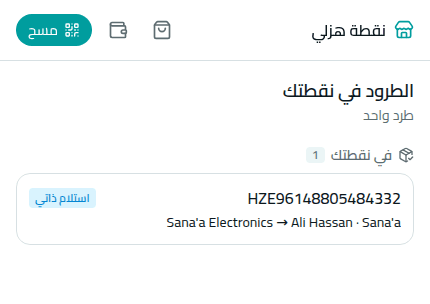
Custody by scan
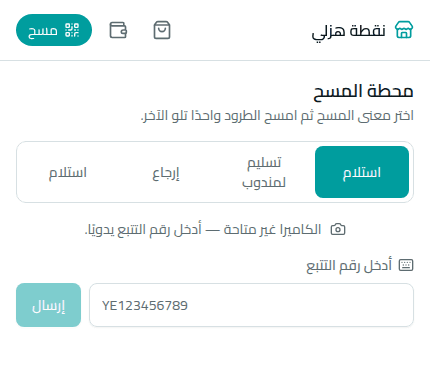
Every handover — seller→point, point→courier, courier→buyer — is proven with a QR scan. Exactly one party is accountable for the parcel at any moment.
The point's earnings
The point earns a handling fee for every parcel that passes through and is delivered, accrued in its own ledger and paid out periodically. Cash stays with the courier.
Staff and branches
A point owner adds staff with scoped roles (manager, cashier, collector, organizer) — each sees and touches only their own job, and every cash collection is attributed to whoever took it. An owner running more than one shop switches branches from the app header.
Opening hours and hub vacation
A point publishes its weekly schedule, showing an Open/Closed chip in the public directory, and its owner can pause new routing temporarily (a break, a holiday) without affecting parcels already in the hub's custody.
Where couriers come from
Becoming a Hezalli driver
Modeled on how large fleets onboard: apply, review, activate. Access is never self-granted.
- 1
Apply
Name, phone, governorate, and vehicle. Files a pending request — grants nothing.
- 2
Admin review
Approve or reject with a note. Every decision is audited.
- 3
Active
Approval grants the courier role — their approved vehicle shapes what parcels they can carry.
Running throughout
Everyone can see where it is
Buyer tracking
A public page, also reachable by scanning the label's QR: an Express badge, the estimated delivery, and a full status timeline.
Dispatch board and SLA
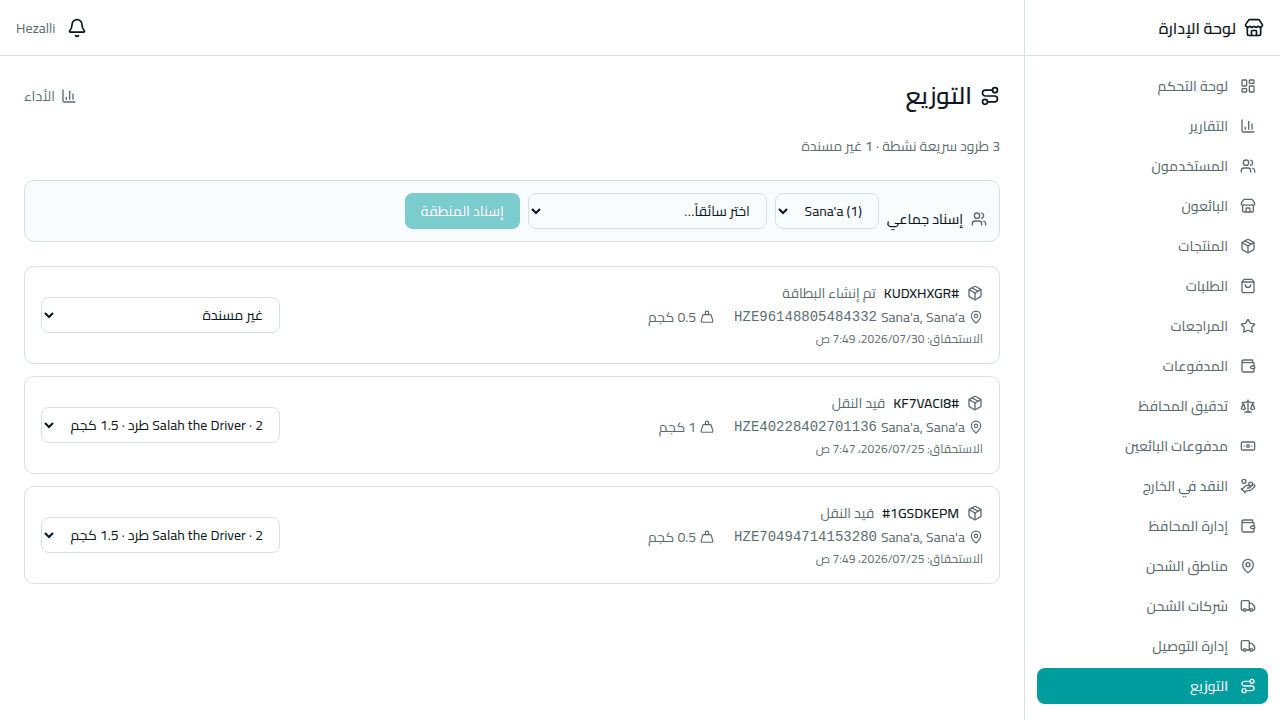
Every in-flight parcel, its courier, and its deadline state. Due-by = shipped + the tier's max ETA; overdue parcels sort to the top.
Beyond the happy path
The parts that make it a real operation
Delivery is never just "drop it off, done." These close the gaps a live fleet actually hits.
Proof of delivery
Recipient name, a doorstep photo, and an optional delivery code — evidence for "never arrived" and COD disputes.
Courier wallet
A per-courier ledger: cash collected minus remitted equals cash on hand, and delivery fees accrue for admins to pay out. A courier remits cash by having their own QR scanned at any hub or desk, and a PIN secures the wallet.
Ratings
Buyers rate the courier 1–5 stars after each delivery; the average shows on the fleet view alongside their offer-acceptance rate.
Live map and push
Buyers pin their address and watch the courier approach; couriers get a push the moment a new offer lands, even with the app closed.
Batch dispatch
Ops staff hand a whole governorate of unassigned parcels to one courier in a single action — no more one-at-a-time clicking.
A distributed ops team
Instead of one admin who sees everything, the team splits into scoped desks — dispatch, the courier fleet, the point network, cash settlement, and network config — each member working only their own desk.
Quality badges
Volume and quality together: hundreds of deliveries, a streak of 5-star ratings, first-attempt success, on-time delivery. Every earned badge raises the courier's cash limit and gives them dispatch priority — and shows to the buyer as a trust card on the tracking page.
Operator reference
The settings
Admin → Settings.
| Setting | Default | What it does |
|---|---|---|
| Pricing basics | ||
express_enabled | true | Master switch. Off = only Standard shows at checkout. |
default_express_fee | 10 | Express price when a store hasn't set its own per-zone fee. |
courier_delivery_fee | 1.5 | What a courier earns per completed delivery. |
| Assignment and offers | ||
courier_assign_strategy | balanced | balanced (fewest jobs) or nearest (distance / governorate). |
courier_offer_timeout_minutes | 60 | Minutes a courier has to accept before it cascades onward. |
courier_offer_max_rounds | 3 | How many couriers to try before escalating to manual dispatch. |
dispatch_hours_start / end | 8 / 21 | The dispatch window, Yemen local time; outside it parcels queue. |
| The open job board | ||
job_board_enabled | false | Post unassigned parcels on a board couriers can claim from. |
job_board_max_active_jobs | 10 | In-flight job cap past which a courier can't claim more. |
| Points and returns | ||
points_enabled | true | Turns on routing parcels through Hezalli Points. |
point_handling_fee | 0.5 | What a point earns per parcel it routes and sees delivered. |
max_delivery_attempts | 3 | Failed attempts before a parcel auto-returns to the seller. |
Where we're headed
Roadmap
Honest about what's still missing — and what's next.
A visual location picker
Buyers can only pin their address via the browser's current-location lookup today. A freely-draggable map with reverse geocoding is the next upgrade for precise routing.
Fleet partnerships
Every courier applies and is approved individually today. A fleet-partner tier would let a delivery company onboard once and run its own drivers underneath.
Live location streaming
The map refreshes every 20 seconds today rather than streaming continuous GPS — a step toward tighter real-time tracking during delivery.
Push notifications
The Web Push plumbing already ships in the code but stays silent until VAPID keys are set in the server environment.
Hezalli Express — a full operator overview